Even More AI Stuff
Ric Kosiba
Jan 23, 2026
This article previously appeared in the Society for Workforce Planning Professionals online journal, On Target. They appear here with the gracious permission of SWPP and Vicky Herrell.
Even More AI Stuff
Ric Kosiba, Managing Director, Real Numbers
Back in 2019, I wrote a piece for On Target called “Calling BS on AI.” I was proud of the title — even if, in hindsight, it should’ve been “Calling BS on a specific AI product” which isn’t quite as catchy.
In it I described an AI project that was failing, although nobody would admit it. It was one of those buzzy, cool-new-things poised to revolutionize our industry. But it didn’t. Here is my I-called-it-first brag: it died the way I predicted.
The signs were there if you knew where to look. It had all the hallmarks of an expensive blunder: designed by a vendor’s product manager who understood AI but not contact centers. The AI model developers never spoke with actual practitioners — their input came solely from that product manager. The result? A solution to a problem that sounded sexy with a lot of marketing hype, but that no one was asking them to solve. In the end, they spent a fortune solving a problem their customers didn’t even have.
A recent MIT study, The GenAI Divide: State of AI in Business 2025, is making the rounds, thanks to one viral stat: 95% of AI projects fail. According to the study, 95% of surveyed AI pilots stall before reaching full production. Side note: I’ve been hearing quiet grumblings of similar failures in our own industry.
There is a lot of chatter about what this failure rate means. Some folks are saying that the initial batch of AI projects are targeting areas like sales and marketing that are easy to grasp but less likely to have a real impact. For instance, using AI to improve the turn of a phrase, highly touted by marketers, just might not be as impactful as people think. Meanwhile, automating back-office functions could be where the real value lies.
Once again, we’re seeing AI deployed with more enthusiasm than precision and the cost of misalignment is mounting.
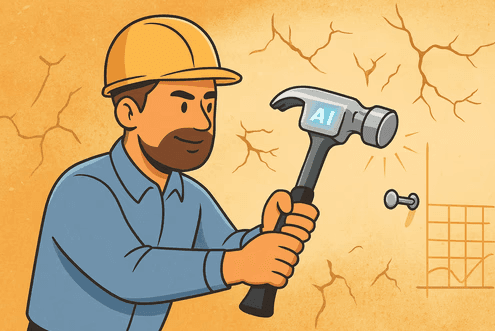
These failures sound a lot like the one I wrote about—people using AI to solve problems that just might not be real. Like with many emerging technologies we are taking our proverbial hammer (AI) and pounding everything with it. At some point we’ll hit a nail, but we are going to destroy a fair number of walls, too.
Let’s talk about AI and workforce management
Interestingly, we are not hearing as much about AI in WFM/contact centers as I’d expect. Wait, that’s not true. All we hear about is AI. We just don’t see as much AI as we would expect. Every webinar I’ve seen of late starts with a marketer telling us how AI will improve our contact center operation and then showcases the same tools we saw last year.
So why hasn’t AI replaced more of our existing tech? Here is my guess.
First, the WFM models and math technologies that we currently use are solid. Our forecasting tools, Holt-Winters, Prophet, ARIMA, and the like, have a robustness that AI doesn’t guarantee. I know that vendors call their models “machine learning” but, you know.
Second, the large language models (LLMs) that impress us in other domains still can’t answer the most basic WFM question: How many people do I need to staff my operation and hit my service goals? That’s because your operation is truly unique — and general-purpose AI doesn’t know how to model it.
Even our old Erlang C/A/X models, which I am not a great fan of, at least behave like a call center should. Every AI model I’ve seen? Not so much.
Third: WFM is hard. It’s a learned niche, not something you pick up from a few blog posts.
I’ve asked several LLMs how to solve specific WFM problems. The answers? Vague and generic, straight out of a WFM marketing brochure. Because, of course, that’s where it gets its information. And some of the answers are just plain wrong. You can make an LLM sound like an engineer, but that doesn’t mean it’s ready to do real engineering.
So, what would we need to do to use AI in WFM?
This might sound strange after everything I’ve said, but I’m a real fan of AI. I believe we are going to end up with some incredible tools to help us manage our work better, even in WFM. But those tools will need a bunch of polish and specific—very specific—know-how. The challenge isn’t the hammer, it’s knowing where the nails are.
First, it will need to be trained to solve our specific problems with expert-class thinking. So far, general whole-internet level knowledge isn’t up to snuff to answering our specific problems. The earliest AI systems, Expert Systems, were built by training models with actual human authorities. I expect we will need to use real WFM experts to train our new models, too.
Second, it will need to interact with our specific modeling technologies. Not just the historical data, but the actual predictive models that help us solve our problems.
Third, we need to be able to ensure that the AI doesn’t make stuff up. Hallucinations in WFM could potentially cost us millions, if unchecked.
Finally, we need to find the killer-AI-app. Tools to make us do our jobs quicker are great, but given our small footprint in an organization, shaving off a WFM head isn’t the big win. Instead, we need to be able to improve the operation itself, to make better decisions, to create better strategies. That’s where the money is.
Remembering a Friend
Finally, just a word about our wonderful Maggie Klenke. She was kind and funny and thoughtful and endlessly generous. I loved talking shop with her.
I can’t think of anyone in our industry who’s done more to educate and uplift us. Maggie taught a whole generation of workforce planners how to do their jobs well, and in doing so, helped create the careers we all enjoy. Let’s all say a prayer of thanks for knowing her.
Ric Kosiba is a charter member of SWPP. Ric is a founder of Real Numbers, a contact center capacity planning and modeling company. He can be reached at ric@realnumbers.com or (410) 562-1217. Please know that he is *very* interested in learning about your business problems and challenges (and what you think of these articles). Want to improve that capacity plan? You can find Ric’s calendar and can schedule time with him at realnumbers.com. Follow Ric on LinkedIn! (www.linkedin.com/in/ric-kosiba/)
Ready to optimize your contact center?
Let our experts show you how Real Numbers can transform your operations.
Join the industry leaders who have already discovered the power of data-driven workforce planning.
Ready to optimize your contact center?
Let our experts show you how Real Numbers can transform your operations.
Join the industry leaders who have already discovered the power of data-driven workforce planning.
Ready to optimize your contact center?
Let our experts show you how Real Numbers can transform your operations.
Join the industry leaders who have already discovered the power of data-driven workforce planning.