The Necessary Components of an Agile Strategic Planning System
Ric Kosiba, Real Numbers
Mar 15, 2026
Years ago, when working at an airline, we had a great idea for improving our contact center operation. It was cheap, and it would require only a desktop computer plus a few weeks of our time. And the potential for significantly cutting costs and improving our customer service was quite high.
We had the approvals, everyone agreed it was smart, and the project’s cost was trivial. But because it was February and the budget had already been locked, we were told to wait eleven months to see if the project might make the approval cut for next year’s budget.
The upside was huge, potentially millions of dollars with only a $15K investment. Looking back, I wonder: how could our business be so thoughtlessly rigid?
Our business wasn’t unusual; many businesses still operate with fixed plans and locked‑down spending. But contact center operations shift constantly; volumes, staffing, shrinkage, routing, everything moves. A static plan is an oxymoron; the operational plan, by its very nature, must be a living, breathing document.
This is the real point: the operation moves, so the plan must move with it.
Contact center plans need regular updates
The old saying that “no battle plan survives first contact with the enemy” is also true of contact center plans and budgets. Business in the real world is messy.
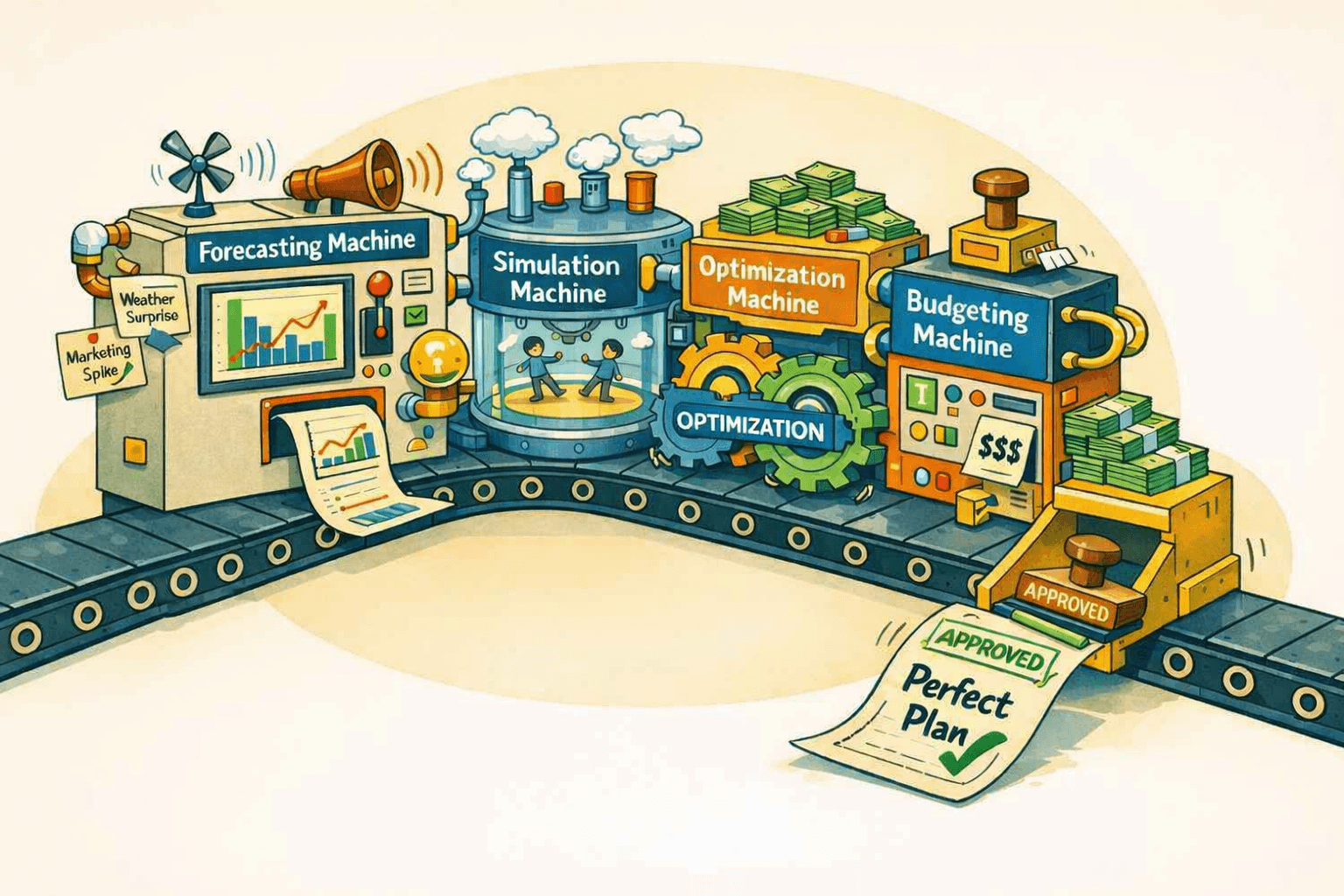
Our staffing plans can’t know about a competitor moving their center down the block from us and poaching our agents, or that the new‑hire classes have higher dropouts than normal. It can’t predict the weather, either. It definitely won’t forsee that our marketing team will drop a mailer without telling the operation first.
Call volumes wander from even the best forecasts, attrition changes, shrinkage moves, our daily patterns shift, and we change the routing. This is simply the nature of our business. Our planning process needs to reflect this ever‑changing operation, and it requires flexibility to model changes as they happen, speed to inform decision‑making, and model accuracy so results are both correct and trusted.
The contact center planning process needs speed
Our operation requires constant monitoring, re‑forecasts, rapid what‑ifs, and fast, advised decision‑making. For a contact center, this means your strategic plan (the 2‑week to 18‑month plan) needs to be revisited regularly and as new information comes in.
What‑ifs can’t take days or weeks. They need to be built in minutes, ideally with decision‑makers in the room as alternative scenarios are worked through.
The contact center planning process needs flexibility
A significant problem with using spreadsheets to develop capacity plans (there are many) is that the ability to create a new and different scenario often requires a significant re‑write of the tool. Spreadsheets just aren’t flexible.
Because our operation is flexible and changing, the planning process—the models—requires flexibility, too
But the contact center planning process mostly requires rigor
It is not enough that the planning process is simple, fast, or nimble—it has to be right. Each iteration of the plan comes with its own assumptions and stretch goals. The analytics that evaluate each scenario—each new strategy—need to mimic the operation as closely as possible.
When building a plan, the level of error should be known and minimized. Processes that can be optimized should be, using true mathematical optimization. Evaluating a strategy requires rigorous simulation with model validations. No Erlang guesses.
What does an optimal contact center planning process look like?
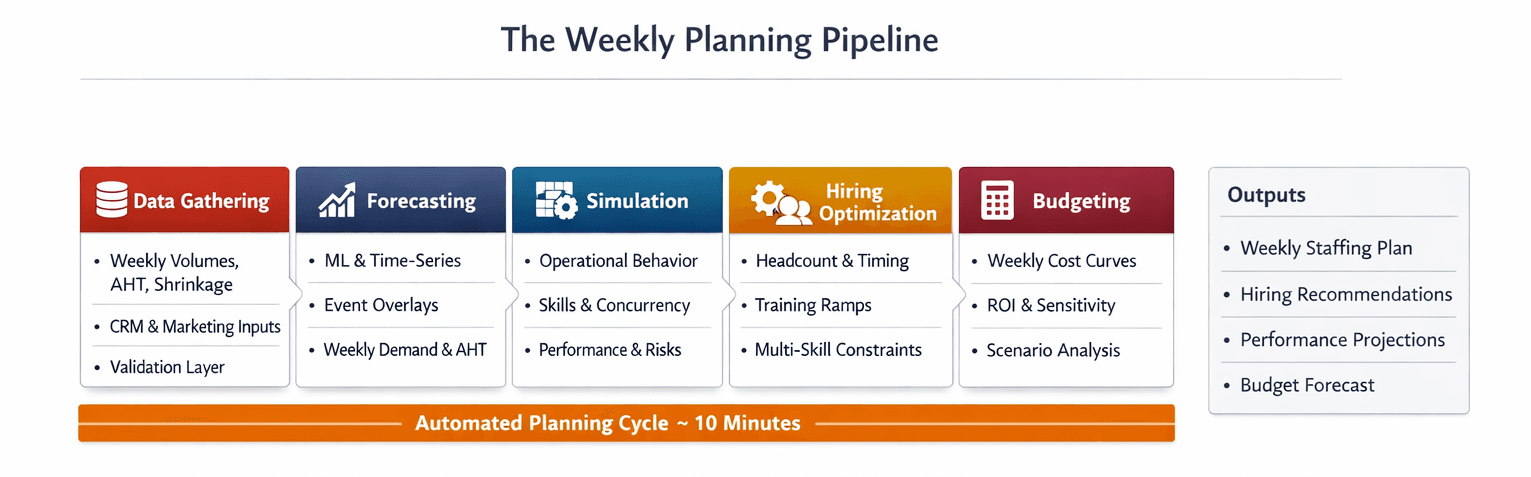
Planning requires a data‑gathering step and four mathematical modeling steps.
The first is ensuring that data is kept at the appropriate level of detail so simulation models can be built, time‑series data is clean for forecasting, anomalies are detected and noted, and there is enough data to identify patterns and seasons. All elements of a contact center plan need to be captured. Volume history is necessary, but other operational metrics are just as critical. A history of each shrinkage category, handle times, schedule adherence, and attrition—by staff group—should be stored.
For forecasting, a good rule of thumb is keeping at least 24 months of time‑series data. Two years of clean data might be a stretch, given the changing business environment, but shorter timeframes can work when paired with an experienced analyst.
For building simulation models, two or three months of interval data is usually sufficient, though more data always helps.
Forecasting mechanics have become simple
Time‑series and machine‑learning algorithms are everywhere and easy to download. But one mistake planners still make is focusing almost entirely on forecasting volumes. Attrition, handle times, and shrinkage rarely get the same level of rigor—even though they matter just as much to the plan.
Simulation models are the core of capacity planning
Simulation models are the critical elements of a great capacity planning process: if the simulation can accurately measure how the operation responds to changes in its performance drivers, you can perform the most important business analytics. Without that accuracy—or with an unvalidated or oversimplified model—the entire planning process becomes suspect.
Building a great operational model requires a deep understanding of the operation: which contacts flow to which staff groups, with what priorities, and under what routing rules. It also requires understanding the statistical distributions that make each contact stream unique. Every contact stream behaves differently, and each one needs its own custom simulation model. Erlang equations are, at best, a weak approximation.
Optimization models then become the engine for decision‑making. They are powerful tools for building just‑in‑time hiring plans and for helping analysts understand the trade‑offs among competing business objectives and constraints. A well‑designed optimization model will automatically determine the best combination of hiring, overtime, and other staffing policies across the planning horizon. A mathematically optimized plan always saves money.
Finally, applying a financial model to the capacity plan reveals the true economics of the operation. Companies can quantify the trade‑offs between service and cost, understand risk versus cost, and—when sales or revenue are involved—analyze profit curves.
When planning is fast and accurate, strategies can be developed in real time, in the boardroom, with executives waiting for results. Operational plans can react to business changes, help decision‑makers understand their trade‑offs as conditions shift, and produce the best response alternatives with full visibility into operational and financial effects.
It is the single best way to truly optimize the operation.
Strategic/capacity planning has always required trade-offs
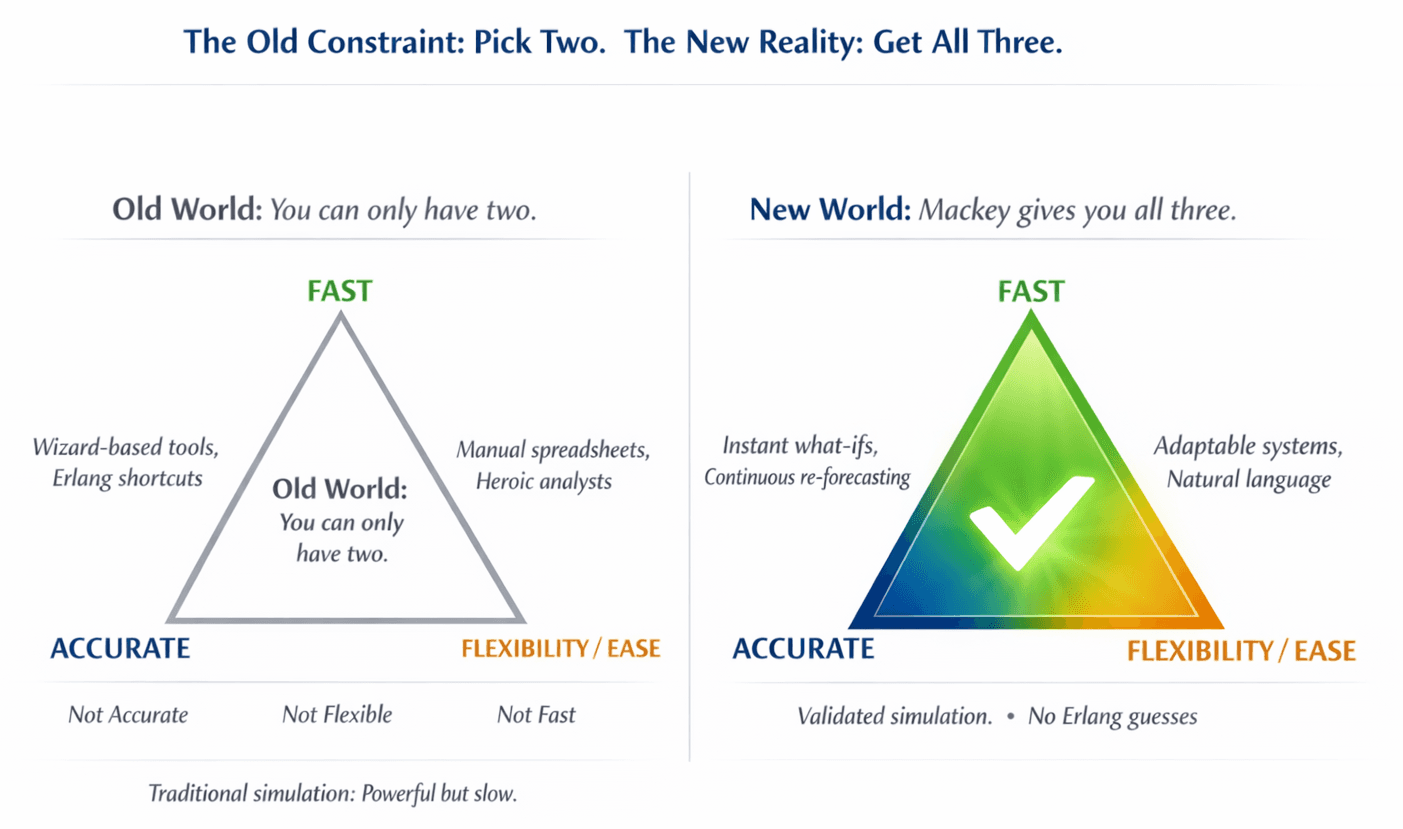
The old meme “you can have two out of three” applies here. The most accurate way to model a contact center has always been discrete‑event simulation. But historically, simulation was far too slow for capacity planning. To simulate a full planning horizon, you’d need to run models for every hour of every day—24 hours × 7 days × 104 weeks—17,472 hours in a two‑year plan. And to get statistical significance, each hour would need a warm‑up period and perhaps twenty runs. When each run takes a few seconds, the time between mouse‑click and result becomes unworkable.
Because of this, most vendors resorted to faster but far less accurate methods: Erlang C, A, or X. Each comes with limiting assumptions. Erlang C assumes no one ever abandons. Erlang A assumes a standard patience distribution that rarely matches reality. Erlang X adds callbacks to Erlang A even though most forecasts already include callbacks implicitly. In practice, Erlang C overstaffs significantly, Erlang X nearly as much, and Erlang A still overstaffs—just slightly less. But they are fast.
Flexibility is inherent in discrete‑event simulation; you can model almost any operation imaginable. Erlang models, by contrast, are single‑queue, single‑channel approximations. To represent a real operation with Erlang math, you end up layering fudge factors onto an already forced model—splitting volumes “in proportion to capacity” or making similar assumptions. It’s awkward, and the results are guesses pretending to be precision.
New model technologies, parallel processing, and, yes, modern AI, are finally making it possible to have all three: accuracy, speed, and ease of use. In our next paper, we’ll explore this.
The last part of the story
Back to my airline story. When we learned we didn’t have approval for the computer or the project, we did what any excited and slightly cocky young team would do: we ignored our bosses. We went hunting for a machine and, on the sly, found an old 286 in a closet (the 286 was ancient even then). We worked weekends to build the system. We implemented it before anyone could tell us “no,” and it worked great. The company didn’t have to wait for its own processes to benefit from a better way of call routing.
But because we built the system so quickly, we never measured the ROI or the payback period. Then, about six months after we launched the system (CaSy), a miracle happened: the hard drive failed. We had to go back to the old process until we could procure a replacement computer—easier now, since it counted as a maintenance item. Suddenly we had an apples‑to‑apples comparison with real data.
The payback period was less than a single day.
Ric Kosiba is a founder of Real Numbers, a contact center capacity planning and modeling company. Ric can be reached at ric@realnumbers.com or (410) 562‑1217.
We are very interested in learning about your business problems and challenges (and what you think of these articles). Want to improve that capacity plan? You can find Ric’s calendar and schedule time with him at realnumbers.com.
Follow Ric on LinkedIn: (www.linkedin.com/in/ric-kosiba/)